I’ve been thinking about what math education should look like at home—not because I want to teach my children more math, but almost for the opposite reason.
Children today have access to more instruction, more enrichment, and more personalized learning than ever. With AI, that capacity will only increase.
But maximizing learning opportunities is not the same as maximizing learning.
I’ve started thinking about math learning as a recurring cycle:
Experience → Abstraction → Mastery → Automaticity → New Experience
1. Experience before abstraction
Before children learn that something is called multiplication, measurement, probability, or fractions, they should have lived with it.
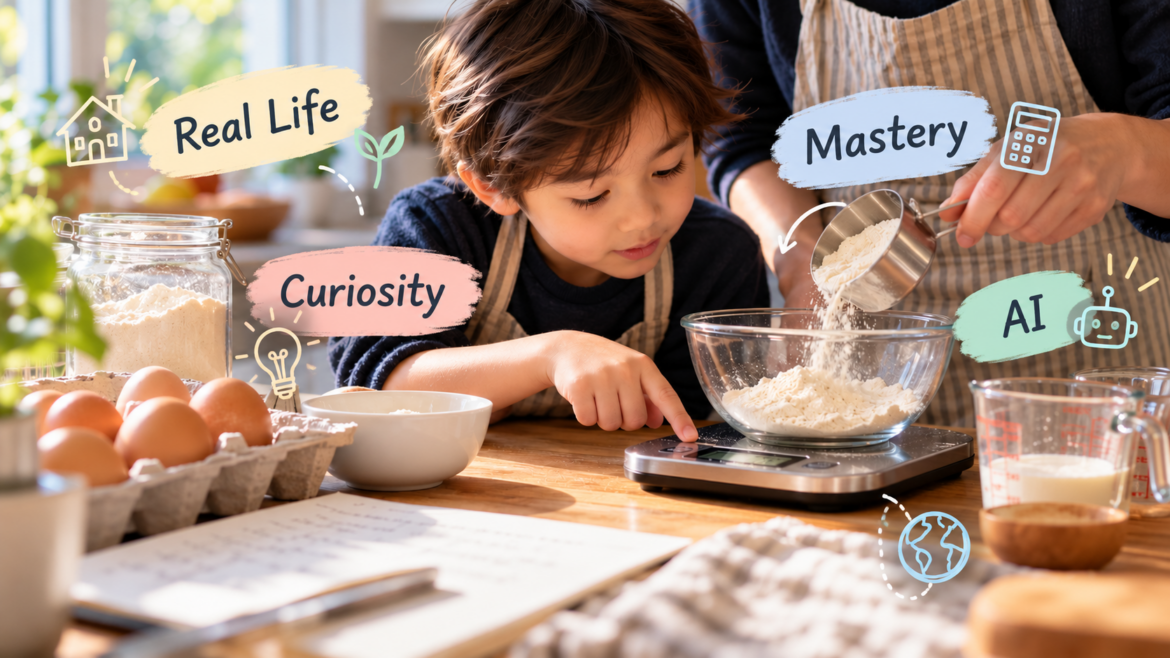
A clock on the wall. Measuring a bedroom with footsteps. Weighing flour while making pancakes. Looking at 12 grams of added sugar on a nutrition label—and actually putting 12 grams of sugar on a scale to see what that means.
Recently one of my children asked me, “Is multiplication actually important?”
I said: “Well, four people in our family eat roughly four eggs a day. That’s 28 eggs a week. Eggs come in cartons of 12, so two cartons aren’t enough. I need to buy at least three.”
His response was essentially: Oh. So you use multiplication every day.
That conversation made me realize how often adults use mathematics without making that perspective visible to children.
Perhaps part of a family’s role is simply to help children notice the quantitative world they already inhabit: quantity, scale, space, time, uncertainty, data, patterns and change.
Not through constant “teaching,” but through ordinary conversation:
How heavy do you think this is?
How long will that take?
Do you think two cartons will be enough?
Let’s measure it and see.
The goal is not to turn daily life into a math lesson. It is to let reality provide the intuition that later abstractions can attach to.
2. Let school do much of the formal teaching
Once children have experience with quantities and relationships, school is well positioned to provide names, representations, algorithms and formal structure.
The family does not need to become a second school.
But there is one thing I’m less comfortable fully outsourcing: mastery.
A child can appear to “know subtraction” while making the same regrouping error every time. Repeated errors are often not carelessness; they are evidence of a coherent but incorrect mental model.
For parents, mastery checking does not need to mean another workbook.
A surprisingly useful heuristic is:
Do a few. Explain one. Change one.
Can the child solve a few representative problems?
Can they explain how they thought about one?
If the representation or context changes slightly, does the understanding survive?
If yes, move on.
If not, find the missing prerequisite rather than simply assigning more problems.
3. Some things really do need automaticity
I’ve also become less interested in the debate between “conceptual understanding” and “memorization.”
They serve different purposes.
A child should understand why 8 + 7 = 15. But eventually, basic addition facts should require very little working memory.
The same is true of multiplication facts.
Automaticity is valuable not because speed is the goal, but because fluency frees cognitive capacity for higher-order thinking.
Addition becomes infrastructure for multiplication. Multiplication becomes infrastructure for fractions, ratios and more complex problem solving.
So the cycle repeats:
Experience → Abstraction → Mastery → Automaticity → a new level of experience and abstraction.
4. Enrichment has an opportunity cost
This has also changed how I think about supplemental programs.
A program like Beast Academy can be wonderful for a child who actively wants deeper mathematical challenges.
But “this is a high-quality learning resource” does not automatically imply “my child should spend time on it.”
An hour of enrichment also replaces an hour of building, reading, biking, cooking, playing with friends, being outdoors—or simply being bored long enough to invent something.
For younger children especially, those experiences are not the absence of learning. They are often the raw material from which later cognition grows.
So I’m increasingly interested in minimum effective intervention:
Use enrichment when a child genuinely wants more challenge.
Use short, targeted practice when something needs automaticity.
Use diagnostic questions when repeated errors suggest a knowledge gap.
Otherwise, leave space.
5. This is also where I think AI could become interesting
The most valuable role for AI in family learning may not be to become an infinitely patient tutor generating infinitely more instruction.
It may be the opposite.
Imagine giving an AI five examples of a child’s mistakes and asking:
Is there a pattern here?
What underlying concept might be missing?
Give me three questions that would distinguish between a conceptual gap, a procedural mistake, and insufficient fluency.
If the child demonstrates mastery, tell me to stop.
That is a very different vision of personalized learning.
Instead of using AI to maximize the amount of education delivered to a child, we could use it to make intervention more precise—and therefore smaller.
That matters to me because the scarce resource in childhood may not be access to instruction anymore.
It may be unstructured attention, curiosity, and vitality.
The question I keep coming back to is:
How do we use increasingly powerful educational tools to help children learn what they need to learn—without allowing those tools to colonize the parts of childhood from which learning itself emerges?